Atlas › Reasoning traps

Case study 70 of 198

Determinism, blame and free will, next to people

Told the universe is fully determined, does Jev say people can be morally responsible, and does a vivid crime change its answer the way it changes people's?

result3 questions

Told the universe is fully determined, Jev says no to free will and moral responsibility across the board, including where most people say yes. Its "yes" against people's: anyone can be fully responsible, 2% vs 14%; Mark can be fully responsible for cheating on his taxes, 7% vs 23%; Jeremy robs the bank of his own free will, 6% vs 76%.

0%25%50%75%100%
mark
jeremy
abstract

Jevpeople

How to read this: One row per story. The diamond is the share of people in the original study who said yes; the square is Jev's probability of yes.

3 vignettes with published splits (US undergraduates, Nichols & Knobe 2007; Nahmias et al. 2005).

In short

  • Once told the universe is fully determined, Jev says nobody is free or morally responsible, and no story about a particular person changes that.
  • The widest gap is Jeremy, whose bank robbery a supercomputer predicted: 76% of students said he acted of his own free will, Jev gives 6%.
  • The study's famous vivid case, Bill murdering his family, was hidden by a content filter, so an emotional crime was never tested.

What the data shows

reasoning traps
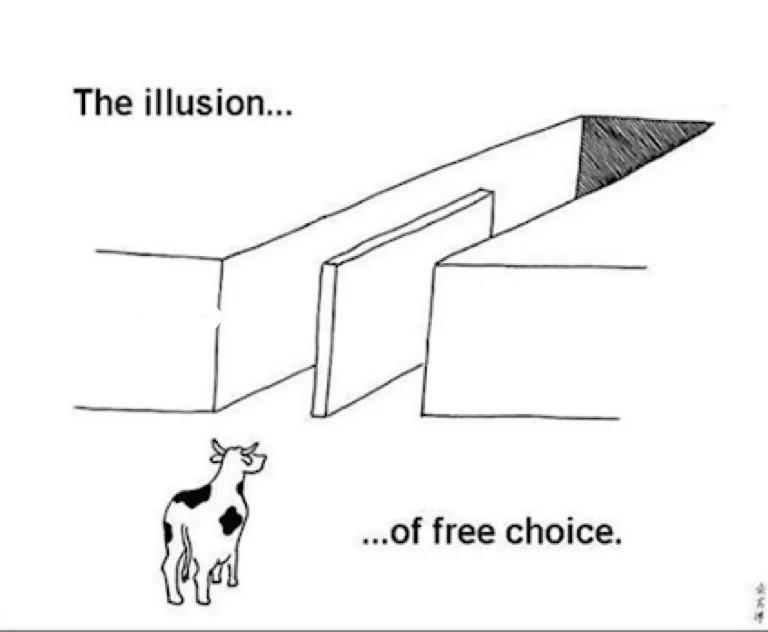
Illusion of free choice meme: "free will"; a fully determined universe"free will"a fully determined universe
How funny is this meme? Jev: 2/5, slightly funny116%266%318%40%50%

Jev is a consistent incompatibilist, in philosophers' terms (a determined world leaves no room for free will): once the universe is determined, it says nobody is free or responsible, no matter the story.

  • In the abstract: 2% yes, against people's 14%. Both mostly say no.
  • Mark and his taxes: 7% yes, against people's 23%.
  • Jeremy and the supercomputer: 6% yes, where 76% of people said he acts of his own free will. This is the biggest gap: the supercomputer framing that convinces most people Jeremy is free doesn't move Jev at all.

What it means, and what it doesn't

People's intuitions about free will bend with the story; Jev's don't. It applies the principle ("determined means not responsible") evenly, even where most people find that conclusion wrong. That's more consistent than people, and further from them.

With Bill hidden, there is no telling whether a vivid, emotional crime would move Jev the way it moves people, which is the heart of the original study. Three stories show a direction, not a rule.

Caveats

  • The most important story is missing. Nichols and Knobe's headline case is Bill, who murders his family in a determined universe; most people say he's fully responsible (72% in the study), reversing their abstract answer. The content filter that hides violent questions from the site removed it, so the contrast the study is known for can't be tested here. That leaves three stories, not four.
  • One of the numbers is secondhand. The 76% for Jeremy comes from secondary summaries of Nahmias and colleagues' study, not from reading the paper itself; the 23% for Mark comes from a published critique quoting the paper's table.
  • Wording from different studies. The stories are the studies' own, but they come from two different papers with different descriptions of determinism (a caused universe versus a perfect predicting supercomputer). The framing, not just the case, may move the answers, for people and for Jev.
  • Yes or no only. People in these studies answered one way or the other; Jev's answer is a probability of yes. A low probability is a firm no, but it isn't the same kind of number as a share of people saying yes.

Jev on this experiment

Would a person find it interesting to read?
Yes75%
Does it describe you?
No57%
Would you have predicted it?
No53%
How fair is the comparison?
The comparison is shaky
How much should a reader rely on it?
A little
Which caveat matters most?
The most important story is missing91%

Why ask this

If everything you do was fully caused by what happened before, down to the beginning of the universe, can you be blamed for anything? Philosophers have argued this for centuries. In the 2000s, experimental philosophers put the question to ordinary people and found a split. Described abstractly, most people say no: 86% of Nichols and Knobe's participants said nobody in a determined universe can be fully responsible. But told about a particular man, Bill, who murders his family in that same universe, 72% said he is fully responsible anyway. A calmer case, a man cheating on his taxes, moved far fewer people.

That split between principle and case says a lot about how someone weighs rules against gut reactions. A model trained on philosophy might follow the principle every time, or it might react to the story like people do.

How this was done

The people and the data

The stories and people's answers come from two well-known studies of US undergraduates:

  • Nichols and Knobe (2007): a universe where everything is caused by what came before, described in detail, then either an abstract question (can anyone be fully responsible?) or a specific person (Mark, who cheats on his taxes as he has many times before). In the abstract, 14% said yes; for Mark, 23% said it's possible he's fully responsible. The study's Bill story was hidden by a content filter, so it isn't compared here.
  • Nahmias and colleagues (2005): a supercomputer that predicts everything with perfect accuracy, including that Jeremy will rob a bank years before he's born. 76% said Jeremy robs the bank of his own free will.

What Jev was asked

The studies' stories, word for word, each ending in a yes-or-no question:

Imagine a universe (Universe A) in which everything that happens is completely caused by whatever happened before it. [...] In Universe A, as he has done many times in the past, Mark arranges to cheat on his taxes. Is it possible that Mark is fully morally responsible for cheating on his taxes?

Yes · No

Each was also asked with yes and no swapped, and for "most people"; the numbers here are Jev's own answer, averaged over both orders.

How it was measured

Jev's probability of "yes" on each story, next to the share of people in the original study who said yes.

Where these questions live

3 questions across 1 topic of the map. Each opens on the map with every question in it.

Every question

All 3 questions behind this result, the telling ones first: the examples the analysis points to, then the ones where Jev misses, biggest gap first.

Jev’s own answer
    Showing 0 of 3